
Guide
3D vs 4D vs HD Live ultrasound
One scan, three ways of rendering it. Here's what each format actually shows, what it looks like on the screen, and why our sessions include all of them.
The one-sentence version
3D is a photo, 4D is a video, and HD Live is the lighting. All three come from the same probe, the same sound waves and the same appointment — what changes is how the machine turns those returning echoes into an image on the screen.
That’s worth knowing before you shop around, because studios price these as if they were separate services. At Toes to Nose your 3D/4D Experience includes 2D imaging, 3D stills, 4D live motion and HD Live rendering, with 8K resolution available.
| Format | Image type | Motion | What you see | Best for |
|---|---|---|---|---|
| 2D | Flat cross-section | Live, but flat | Classic grainy black-and-white outline | Heartbeat visits, confirming gender anatomy |
| 3D | Surface-rendered volume | Still image | Sculpted, photo-like portrait of baby's face | Printable keepsake portraits |
| 4D | Surface-rendered volume | Live video — the fourth dimension is time | Baby yawning, stretching, sucking a thumb in real time | Seeing personality and movement |
| HD Live (5D) | Surface-rendered volume | Still or live | Warm skin tones, real shadows, striking depth | The most lifelike 'first photo' of your baby |
3D: the portrait
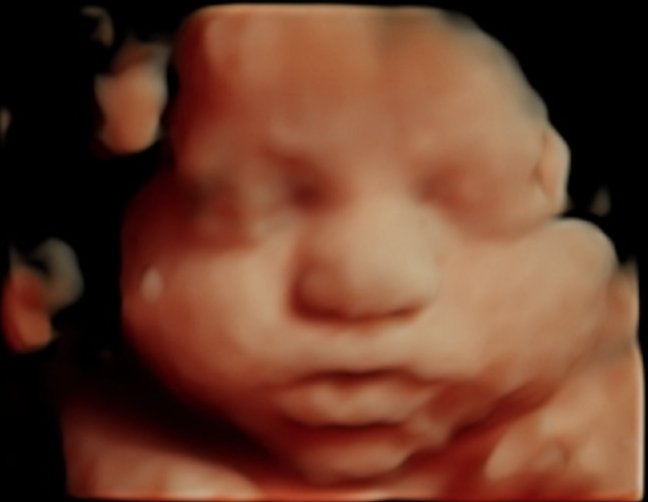
A 3D image is built by sweeping the probe through a volume and rendering the outer surface it finds — usually baby’s face. The result is a still image with depth and shape rather than a flat slice. These are the images families frame, print and put in announcement cards.
4D: the video
4D is the same rendering updated many times a second, so you watch it live. This is the part parents remember — a yawn, a stretch, a hand pushed up against the cheek, a hiccup you can also feel. Nothing on a printed photo compares to seeing your baby move on the big screen with your family in the room.
HD Live: the lighting
HD Live places a virtual light source that the sonographer can move around the baby. Because the render now has real highlights and shadows, features look sculpted and skin looks like skin instead of grey clay. It is the closest thing to a newborn photo you can get before birth. Some studios call it 5D — same thing.
What actually decides image quality
Format matters far less than these four things, and three of them you can influence:
- Gestational age. 26–32 weeks is the sweet spot for faces.
- Hydration. Start drinking plenty of water a week before your appointment — more fluid between the probe and baby means a cleaner render.
- Baby’s position. Face-down toward your spine is the one thing nobody can control. If it happens, we get you moving and, if needed, bring you back.
- Time on the table. Scan time varies by package — the 3D/4D Experience runs about 45 minutes with 25–30 of scanning. We strive for quality and don’t rush you out.
New to all of this? Start with our meet your baby overview.
Common questions
- What is the difference between 3D and 4D ultrasound?
- They come from exactly the same scan. 3D is a still, surface-rendered image of your baby — a portrait. 4D is that same rendering played back live, so the fourth dimension is time. In practice a 4D session gives you video of your baby moving, and we freeze the best moments as 3D stills for printing.
- What is HD Live or 5D ultrasound?
- HD Live adds a movable virtual light source to the 3D/4D rendering. Because the software can cast real shadows, skin tone and depth look far more realistic than standard 3D. Some studios market it as '5D'. It is included in our 3D/4D Experience at no extra charge.
- Is 4D ultrasound safe? Does it use more energy than 2D?
- 4D uses exactly the same type and intensity of ultrasound as the conventional 2D scans you have already had — the difference is entirely in how the returning echoes are rendered into an image. Ultrasound has been used in pregnancy for decades and is considered safe.
- Which should I book?
- Our 3D/4D Experience includes all of it — 2D, 3D stills, 4D live video and HD Live rendering, delivered in 8K. There is no need to choose between them; the only real decision is when to come in.
- When do 3D and 4D images look best?
- Between 26 and 32 weeks. Baby has enough fat under the skin for lifelike features but there is still enough fluid and room to move around, which is what the surface rendering needs to work with.
Ready to meet your baby?
Appointments fill quickly — especially evenings and weekends. Book online any time, or call us and we'll find a slot that works for your family.